"I'm a big fan of money. I like it, I use it, I have a little. I keep it in a jar on top of my refrigerator. I'd like to put more in that jar. That's where you come in."
I'm not a big fan of Adam Sandler, but his voice (as Robbie Hart in the Wedding Singer) came to me as I searched - fruitlessly - on Trademe for a replacement iPod for less than $20. (yes, I'm still grieving).
His words also come to me when I'm searching for special deals on holidays/petrol/clothes/music/wine. Anything, really - as long as I'm paying less than I normally would, I'm winning.
Money. That's what I want.
While I can't claim to have ever been poverty-stricken, I'm no stranger to finding my cupboards bare following a poorly-timed over-indulgence with my eftpos card. I've been known to live off carrots or silverbeet for days at a time (for reasons other than my own weird experimentation with vegetarianism) and, despite the fact I have been an 'adult' for some years now, there are still times when paying the bills requires a call to my dear Ma and Pa. Shameful.
I can blame the recession; I blame my non-lucrative career path; I can blame my student loan; I can blame the windowed envelopes that cruelly appear in my letterbox more often than should be considered fair. (note: red wine and chocolate are up there with oxygen and water and therefore do not count as financial burdens).
Burdens aside, I can't help but admit that I have always been - and probably always will be - poor. Even when I was earning a relatively decent wage (working for a certain call centre that shall remain nameless) and paying minimal bills, my bank balance seemed to hover around zero more frequently than not. Whatever it was I needed, I had to have - and then lamented not having more.
These days, I depend on automatic payments to keep my money in a safe place (under the bed does not work). Because, while getting rid of $100 over the counter in Portmans takes but a relatively painfree swipe of an eftpos card, the act of actually transferring a monetary sum from one bank account to another hurts. Don't ask me why - maybe it's something to do with seeing numbers drop before my eyes and not having something tangible (i.e, red wine/chocolate/new hot-off-the-catwalk boots) to replace it.
But if I'm to buy that new iPod (not a Touch, mind - I can't afford that) or visit India's fair shores again, then it's carrots and silverbeet for a few more years yet.
Of course, the cupboard is never bare at mum and dad's...
Wednesday, April 21, 2010

Tuesday, April 13, 2010
when the ambulances have gone.
It's an eerie place, the edge of a state highway.
It's a place littered with McDonald's cups and split rubbish bags and beer bottles, with broken tarseal and wild blackberry and possum carcasses. It's a place not often tread by human feet; certainly not by the leather-bound feet of myself, armed with camera and notebook.
Today I stood on the edge of State Highway 27, calmly swapping my wide-angle camera lens for a zoom so I could get a better shot of the carnage spread across the road.
It's the silence and stillness that haunted me first. The 100kph buzz of cars and trucks had been diverted down another road. All that remained on that stretch of highway was sirens in the distance, flashing red and blue lights and a wrecked car covered with a tarpaulin.
It wasn't until later, as I picked my way back over the roadside rubbish (I remember a yellowing phonebook and a glossy packet of cigarettes) that one of the officers told me someone had died.
An eerie, empty feeling.
Oddly, it was my morbid curiosity for these situations as a kid that is in part to blame for where I was today. I grew up on a farm on the same highway and, whenever cars ploughed through our front fence (fairly regularly in the winter) I'd dig out the binoculars and jump on my BMX and go for a gawk.
Perhaps I was a weird, morbid kid.
But, shocking as today's fatal was - and as any accident is - we still want to know about it.
These days, I go as a reporter, not a rubber-necker; I get in and get out again as soon as possible. Most of the time, there's nothing major to report. A mishap with a power pole, a scrape in the car park, a bumper-to-bumper.
It's still news, even if the cars usually suffer more than the people.
Other than the purposes of satisfying our (shared) curiosity for the morbid side of life, I'd like to think there's some good in my having to stand on the roadside today.
Driving back to Tirau down that same highway tonight, with the image of that orange tarpaulin over crumpled metal still fresh in my mind, I found myself holding back from over-taking the slow truck ahead of me. A few hours earlier I wouldn't have thought twice about it.
And, as I watched a sleek sedan defy an oncoming truck to pass six cars in a row, I hoped the driver would be reading the newspaper.
It's a place littered with McDonald's cups and split rubbish bags and beer bottles, with broken tarseal and wild blackberry and possum carcasses. It's a place not often tread by human feet; certainly not by the leather-bound feet of myself, armed with camera and notebook.
Today I stood on the edge of State Highway 27, calmly swapping my wide-angle camera lens for a zoom so I could get a better shot of the carnage spread across the road.
It's the silence and stillness that haunted me first. The 100kph buzz of cars and trucks had been diverted down another road. All that remained on that stretch of highway was sirens in the distance, flashing red and blue lights and a wrecked car covered with a tarpaulin.
It wasn't until later, as I picked my way back over the roadside rubbish (I remember a yellowing phonebook and a glossy packet of cigarettes) that one of the officers told me someone had died.
An eerie, empty feeling.
Oddly, it was my morbid curiosity for these situations as a kid that is in part to blame for where I was today. I grew up on a farm on the same highway and, whenever cars ploughed through our front fence (fairly regularly in the winter) I'd dig out the binoculars and jump on my BMX and go for a gawk.
Perhaps I was a weird, morbid kid.
But, shocking as today's fatal was - and as any accident is - we still want to know about it.
These days, I go as a reporter, not a rubber-necker; I get in and get out again as soon as possible. Most of the time, there's nothing major to report. A mishap with a power pole, a scrape in the car park, a bumper-to-bumper.
It's still news, even if the cars usually suffer more than the people.
Other than the purposes of satisfying our (shared) curiosity for the morbid side of life, I'd like to think there's some good in my having to stand on the roadside today.
Driving back to Tirau down that same highway tonight, with the image of that orange tarpaulin over crumpled metal still fresh in my mind, I found myself holding back from over-taking the slow truck ahead of me. A few hours earlier I wouldn't have thought twice about it.
And, as I watched a sleek sedan defy an oncoming truck to pass six cars in a row, I hoped the driver would be reading the newspaper.
Wednesday, April 7, 2010
coming home.
Like most high school kids, I wanted to leave my home town the minute I put down my pen at the end of my last Bursary exam.
During those years, references to our harmless little town usually revolved around the words "hole", "dump", or even "Hell".
Such is teenage angst.
True to our word, most of us did leave immediately, pursuing university degrees or travel or jobs in other, 'better' towns or cities. Anywhere but here, we said.
And now, most of us are back.
Walking down the street now, I am as likely to pass someone I went to school with as if I am actually back on school grounds. The guy at the gym, the girl at the supermarket checkout, the couple pushing a baby's pram down the main street. Physique isn't all that has changed with growing up; somewhere along the way, we changed our minds about Matamata.
So, were we wrong?
It's true that Matamata has changed as well. As much respect I have for the place now, I am sure it actually was something of a hole at some point. In the five years after I left, Matamata gained a shiny new New World, a McDonalds, Robert Harris and several swanky boutique-y style shops. Lord of the Rings helped; the tourist interest in the few remaining Hobbit holes is yet to wane. In fact, the next movie 'The Hobbit' will only bring more hordes of fantasy enthusiasts clambering to have their photo taken with the Gollum statue in the centre of town.
Still, as fancy as Matamata has become, I think there's some truth to "Home Sweet Home", and the old addage, "you don't know what you've got til it's gone".
I don't mind admitting that while my cold, draughty bedroom in my first Wellington flat spoke volumes (albeit barely audible over the howling wind) about freedom and indepedence, it lacked something that couldn't be posted in one of my mum's care packages.
Familiarity.
And so, like others in my year who lamented our lack of a cinema/night club/coffee bar, I've learned to appreciate that bigger isn't always better. That there is comfort in knowing the person who just vaccinated your dog is a friend of your parents and that the lady doing the wine tastings at the supermarket knows your favourite red.
Anonymity can be lonely. And, really, there's no place like home.
Perhaps not for good, but for now.
During those years, references to our harmless little town usually revolved around the words "hole", "dump", or even "Hell".
Such is teenage angst.
True to our word, most of us did leave immediately, pursuing university degrees or travel or jobs in other, 'better' towns or cities. Anywhere but here, we said.
And now, most of us are back.
Walking down the street now, I am as likely to pass someone I went to school with as if I am actually back on school grounds. The guy at the gym, the girl at the supermarket checkout, the couple pushing a baby's pram down the main street. Physique isn't all that has changed with growing up; somewhere along the way, we changed our minds about Matamata.
So, were we wrong?
It's true that Matamata has changed as well. As much respect I have for the place now, I am sure it actually was something of a hole at some point. In the five years after I left, Matamata gained a shiny new New World, a McDonalds, Robert Harris and several swanky boutique-y style shops. Lord of the Rings helped; the tourist interest in the few remaining Hobbit holes is yet to wane. In fact, the next movie 'The Hobbit' will only bring more hordes of fantasy enthusiasts clambering to have their photo taken with the Gollum statue in the centre of town.
Still, as fancy as Matamata has become, I think there's some truth to "Home Sweet Home", and the old addage, "you don't know what you've got til it's gone".
I don't mind admitting that while my cold, draughty bedroom in my first Wellington flat spoke volumes (albeit barely audible over the howling wind) about freedom and indepedence, it lacked something that couldn't be posted in one of my mum's care packages.
Familiarity.
And so, like others in my year who lamented our lack of a cinema/night club/coffee bar, I've learned to appreciate that bigger isn't always better. That there is comfort in knowing the person who just vaccinated your dog is a friend of your parents and that the lady doing the wine tastings at the supermarket knows your favourite red.
Anonymity can be lonely. And, really, there's no place like home.
Perhaps not for good, but for now.
Tuesday, March 23, 2010
Someone said to me today, "I see that Tiger Woods is ----"
I didn't hear the rest of the sentence because my brain shut off.
Tiger Woods' affair, Lindsay Lohan's tattoo, Brangelina's latest hand-picked infant - it all leaves me cold. I don't care. I simply. do. not. care.
I once had a flatmate who craved celebrity gossip. Our flat was littered with the faces of the aforementioned and a thousand other Somebodies who were regularly plastered all over OK! and Hello! and New Weekly magazines. Cameron Diaz and Drew Barrymore gaped up at us from the coffee table; Owen Wilson's giant nose greeted us in the toilet. Those magazines were the backdrop to my uni years and probably ate up hours that should have spent studying or writing essays.
Unfortunately, although my knowledge of who wore what at the Oscars and the latest "baby belly" spotting was excellent, it didn't fair well when it came to relaying the finer details of punishment in modern society in my third-year Criminology exams.
These days, the only time my fingers are guilty of turning the pages of New Idea or suchlike are if I'm in a hospital waiting room or at the hairdressers.
I have no craving for Hollywood gossip. In fact, I find it somewhat satisfying that I no longer recognise some celebrities. While I'm a long way from the bliss of being able to say, "Paris who?" I find that my social standing in the world has not suffered for not knowing where Jennifer Aniston bought her earrings.
In fact, having more or less freed myself from a constant barrage of flawless American stick insects has probably added a few years to my life. Not to mention saved a few braincells.
So, if Tiger Woods heads the 6 'o clock news again this week, I'll be reaching for the remote and seeking out an otherwise untainted form of news. The newsletter in the Hubbards cereal box, perhaps.
I didn't hear the rest of the sentence because my brain shut off.
Tiger Woods' affair, Lindsay Lohan's tattoo, Brangelina's latest hand-picked infant - it all leaves me cold. I don't care. I simply. do. not. care.
I once had a flatmate who craved celebrity gossip. Our flat was littered with the faces of the aforementioned and a thousand other Somebodies who were regularly plastered all over OK! and Hello! and New Weekly magazines. Cameron Diaz and Drew Barrymore gaped up at us from the coffee table; Owen Wilson's giant nose greeted us in the toilet. Those magazines were the backdrop to my uni years and probably ate up hours that should have spent studying or writing essays.
Unfortunately, although my knowledge of who wore what at the Oscars and the latest "baby belly" spotting was excellent, it didn't fair well when it came to relaying the finer details of punishment in modern society in my third-year Criminology exams.
These days, the only time my fingers are guilty of turning the pages of New Idea or suchlike are if I'm in a hospital waiting room or at the hairdressers.
I have no craving for Hollywood gossip. In fact, I find it somewhat satisfying that I no longer recognise some celebrities. While I'm a long way from the bliss of being able to say, "Paris who?" I find that my social standing in the world has not suffered for not knowing where Jennifer Aniston bought her earrings.
In fact, having more or less freed myself from a constant barrage of flawless American stick insects has probably added a few years to my life. Not to mention saved a few braincells.
So, if Tiger Woods heads the 6 'o clock news again this week, I'll be reaching for the remote and seeking out an otherwise untainted form of news. The newsletter in the Hubbards cereal box, perhaps.
Tuesday, March 16, 2010
after video killed the radio stars
About a month ago, I lost a dear friend. A friend who had rarely left my side for nearly three years; a friend who accompanied me every day to and from work, who never failed to light up my day, didn't mind my off-key singing or bad driving... and fitted into my handbag.
Yes, I admit it. I was deeply attached to my iPod and I am still grieving its loss.
The death of said iPod was nothing short of dramatic. For the last two years, I have battled with a cheap made-in-China, bought-on-Trademe transmitter whose function has steadily declined. Frequent wrestling with the dodgy fuses and cheap plastic casing was its undoing; on Doomsday, the wires had actually come free and lodged themselves deep within the carpet on the floor of my car. I lack any sort of patience for malfunctioning technology; I shoved the mess aside (iPod still attached) stuck a CD in and drove home.
If the drive had been any longer than 15 minutes, my iPod wouldn't have been the only charred occupant in my car. In any case, by the time I reached home my sleek silver-faced companion was little more than a skin-blistering lump of grey metal.
I think my grief was less about the loss of 20gb worth of music (thankfully preserved by my computer). It wasn't really even facing the cost of forking out for a replacement between bills, my next warrant of fitness, petrol, food, new shoes, wine... a new iPod is quite a long way down the list.
No, the real tragedy was realising how attached I had become to 140 grams worth of metal and buttons.
I could argue it was a matter of convenience. My iPod was significantly easier to lug around than six bulky CD cases; not to mention safer (changing CDs whilst driving is something I do not endorse).
It's not even about having something that everyone has. Keeping up with the Cool Kids. Ipods are almost outdated now anyway - everyone I know has an iPhone.
If I'm honest, I think it was the fact that I could show I had music. And that I could have that music anywhere, anytime. Music I loved, music I hated, music I didn't care for one way or another. Song after song, album after album; every artist I had ever heard of and some I hadn't. Twenty gigabites of sound I had spent years collecting. I don't even know what a gigabite is. All I knew was that I had a lot of music, and that meant I was Knowledgeable. I had Taste.
Without the iPod, I am shamefully reduced to nothing but six CD cases of (mostly) burned CDs. My true identity is revealed. To real collectors of music, I am a fake. An imposter. I am no longer able to hide behind the satifying click-click of a scrolling menu and a illuminated screen.
If there's a lesson in this, I don't want to hear it. I can afford neither a new iPod nor 'real' CDs. And I refuse to fill my car with blank-faced CDs covered in sloppy handwriting.
So, until either Santa comes through or I win Lotto, I am back to how they did it in the good old days; Radio New Zealand and my own vocal chords.
And driving solo.
Yes, I admit it. I was deeply attached to my iPod and I am still grieving its loss.
The death of said iPod was nothing short of dramatic. For the last two years, I have battled with a cheap made-in-China, bought-on-Trademe transmitter whose function has steadily declined. Frequent wrestling with the dodgy fuses and cheap plastic casing was its undoing; on Doomsday, the wires had actually come free and lodged themselves deep within the carpet on the floor of my car. I lack any sort of patience for malfunctioning technology; I shoved the mess aside (iPod still attached) stuck a CD in and drove home.
If the drive had been any longer than 15 minutes, my iPod wouldn't have been the only charred occupant in my car. In any case, by the time I reached home my sleek silver-faced companion was little more than a skin-blistering lump of grey metal.
I think my grief was less about the loss of 20gb worth of music (thankfully preserved by my computer). It wasn't really even facing the cost of forking out for a replacement between bills, my next warrant of fitness, petrol, food, new shoes, wine... a new iPod is quite a long way down the list.
No, the real tragedy was realising how attached I had become to 140 grams worth of metal and buttons.
I could argue it was a matter of convenience. My iPod was significantly easier to lug around than six bulky CD cases; not to mention safer (changing CDs whilst driving is something I do not endorse).
It's not even about having something that everyone has. Keeping up with the Cool Kids. Ipods are almost outdated now anyway - everyone I know has an iPhone.
If I'm honest, I think it was the fact that I could show I had music. And that I could have that music anywhere, anytime. Music I loved, music I hated, music I didn't care for one way or another. Song after song, album after album; every artist I had ever heard of and some I hadn't. Twenty gigabites of sound I had spent years collecting. I don't even know what a gigabite is. All I knew was that I had a lot of music, and that meant I was Knowledgeable. I had Taste.
Without the iPod, I am shamefully reduced to nothing but six CD cases of (mostly) burned CDs. My true identity is revealed. To real collectors of music, I am a fake. An imposter. I am no longer able to hide behind the satifying click-click of a scrolling menu and a illuminated screen.
If there's a lesson in this, I don't want to hear it. I can afford neither a new iPod nor 'real' CDs. And I refuse to fill my car with blank-faced CDs covered in sloppy handwriting.
So, until either Santa comes through or I win Lotto, I am back to how they did it in the good old days; Radio New Zealand and my own vocal chords.
And driving solo.
Sunday, March 7, 2010
attention reader's!
Perhaps it's the industry I work in; perhaps it's the fact that my mum was a schoolteacher. Or, perhaps it's that I'm a pedantic lunatic with nothing better to do.
But when someone jams an apostrophe where it shouldn't be, I want to scratch my eyeballs out and scream with rage and pain and sheer frustration.
Why, oh why, can't anybody get it right these days? There seems to be an urgency, a desperate yearning to thrust that tiny mark into a word whenever an 's' appears. And, considering how often the English language is beaten down into almost code form for the sake of faster, easier communication, it makes no sense that anybody would take the time to ADD another character.
And yet, I could put money on coming across at least one monstrosity every day:
"Boat's for hire" (a sign in Tapu)
"Closed on Monday's" (outside a certain cafe in Matamata)
"I saw you're sister in the weekend!" (on Facebook)
Right - let's go back to primary school.
A textbook will tell you that an apostrophe is either used to signify an omitted letter or letters from a word, or to signify possession.
One doesn't have to be a geek or even good at English to get the damn thing right.
But I'm not about to turn this rant into a lesson in grammar. That's what teachers are paid for. Obviously, though, not paid enough; it seems learning how to punctuate correctly has neatly slipped off the school curriculum.
Perhaps it's not all the fault of teachers. Ignorance of the apostrophe - along with correct spelling - has been exacerabated by modern forms of communication. Which isn't going to go away in a hurry. Which, to the anguish of geeks like myself, means the English language is only going to be twisted further and further out of shape.
And now, to add insult to injury, it seems even journalists - the last hope we have of preserving true English - are now falling prey to "if you can't beat 'em, join 'em"...
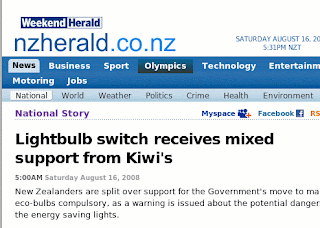
But when someone jams an apostrophe where it shouldn't be, I want to scratch my eyeballs out and scream with rage and pain and sheer frustration.
Why, oh why, can't anybody get it right these days? There seems to be an urgency, a desperate yearning to thrust that tiny mark into a word whenever an 's' appears. And, considering how often the English language is beaten down into almost code form for the sake of faster, easier communication, it makes no sense that anybody would take the time to ADD another character.
And yet, I could put money on coming across at least one monstrosity every day:
"Boat's for hire" (a sign in Tapu)
"Closed on Monday's" (outside a certain cafe in Matamata)
"I saw you're sister in the weekend!" (on Facebook)
Right - let's go back to primary school.
A textbook will tell you that an apostrophe is either used to signify an omitted letter or letters from a word, or to signify possession.
One doesn't have to be a geek or even good at English to get the damn thing right.
But I'm not about to turn this rant into a lesson in grammar. That's what teachers are paid for. Obviously, though, not paid enough; it seems learning how to punctuate correctly has neatly slipped off the school curriculum.
Perhaps it's not all the fault of teachers. Ignorance of the apostrophe - along with correct spelling - has been exacerabated by modern forms of communication. Which isn't going to go away in a hurry. Which, to the anguish of geeks like myself, means the English language is only going to be twisted further and further out of shape.
And now, to add insult to injury, it seems even journalists - the last hope we have of preserving true English - are now falling prey to "if you can't beat 'em, join 'em"...

Sunday, February 28, 2010
when disaster strikes...
We Kiwis are a funny bunch.
News breaks of a tsunami on its way and a bunch of us head to the beach for a nosy.
Some take surfboards.
Idiots, the rest of us say, shaking our heads.
But what did the rest of us do?
When Civil Defence told those living on the East Coast to start gathering bottles of water, tinned food and clothing and head inland, how many listened? How many threw off the duvet covers, screamed at their sleeping partner to start packing, and ran through the house collecting their non-waterproof treasures before heading for the hills?
At home in Tirau, some 50 minutes from the nearest coast, I got out of bed and ran. And ran home again. Like I do every morning. I actually forgot about the tsunami alert until I was eating breakfast. By then, warnings about a "massive wall of water" had been downgraded to "waves measuring 20cm high".
Hardly worth getting out of bed for.
To be fair, most people were probably still snoring soundly when that first news bulletin hit the airwaves. It was Sunday, after all. The rest, I suppose, either yawned and made a cup of tea, or cracked a few eggs into the frying pan, or just changed channels.
She'll be right, we said.
It makes me wonder: how would the average Kiwi cope in the face of real disaster? We seem to hear about some part of the world devastated by tsunami, earthquake, bush fire, terrorist attack every few weeks now. And sure, we've had our share of earthquakes and volcanic eruptions in the past, but nothing compared to Haiti or Chile or even the Aussie bushfires. Events where 'she'll be right' wouldn't quite cut it.
It just doesn't seem quite real.
And, to be honest, every time another disaster strikes, our memories of the preceeding one fade a little more quickly. We hear the numbers of dead and injured and missing, and we despair; then we forget.
Like Fredd Dagg said, "we don't know how lucky we are, mate."
But maybe there's something to be said for living in the moment. Sure, we can sympathise with those whose lives are torn apart and we can fill our basements with tinned baked beans and decks of playing cards in preparation for Doomsday. We can practise fire drills and earthquake drills and build ourselves a bomb shelter complete with flush toilet and home theatre system.
But, in the end, if a freak wave or a cyclone is on its way, there's sweet Fanny Adams we can do about it. It's gonna happen, whether we're 'ready' or not. The best we can do it is live each day as it comes.
And maybe have a surfboard on hand.
News breaks of a tsunami on its way and a bunch of us head to the beach for a nosy.
Some take surfboards.
Idiots, the rest of us say, shaking our heads.
But what did the rest of us do?
When Civil Defence told those living on the East Coast to start gathering bottles of water, tinned food and clothing and head inland, how many listened? How many threw off the duvet covers, screamed at their sleeping partner to start packing, and ran through the house collecting their non-waterproof treasures before heading for the hills?
At home in Tirau, some 50 minutes from the nearest coast, I got out of bed and ran. And ran home again. Like I do every morning. I actually forgot about the tsunami alert until I was eating breakfast. By then, warnings about a "massive wall of water" had been downgraded to "waves measuring 20cm high".
Hardly worth getting out of bed for.
To be fair, most people were probably still snoring soundly when that first news bulletin hit the airwaves. It was Sunday, after all. The rest, I suppose, either yawned and made a cup of tea, or cracked a few eggs into the frying pan, or just changed channels.
She'll be right, we said.
It makes me wonder: how would the average Kiwi cope in the face of real disaster? We seem to hear about some part of the world devastated by tsunami, earthquake, bush fire, terrorist attack every few weeks now. And sure, we've had our share of earthquakes and volcanic eruptions in the past, but nothing compared to Haiti or Chile or even the Aussie bushfires. Events where 'she'll be right' wouldn't quite cut it.
It just doesn't seem quite real.
And, to be honest, every time another disaster strikes, our memories of the preceeding one fade a little more quickly. We hear the numbers of dead and injured and missing, and we despair; then we forget.
Like Fredd Dagg said, "we don't know how lucky we are, mate."
But maybe there's something to be said for living in the moment. Sure, we can sympathise with those whose lives are torn apart and we can fill our basements with tinned baked beans and decks of playing cards in preparation for Doomsday. We can practise fire drills and earthquake drills and build ourselves a bomb shelter complete with flush toilet and home theatre system.
But, in the end, if a freak wave or a cyclone is on its way, there's sweet Fanny Adams we can do about it. It's gonna happen, whether we're 'ready' or not. The best we can do it is live each day as it comes.
And maybe have a surfboard on hand.
Subscribe to:
Posts (Atom)
